


“When the world wearies and society fails to satisfy, there is always the garden” – Minnie Aumonier
The practice of utilizing gardens to facilitate the human healing process is not a new phenomenon. Throughout history, gardens have been used for this purpose. Examples include the Japanese Zen garden and the Monastic Cloister garden. However, in the 20th century, using gardens for their healing benefits began to decline with the rise of medical technology. In more recent times, however, interest in gardens as a modality for facilitating healing has grown. This is partly due to the growing interest in complementary and alternative therapies, which take a holistic approach, focused on healing the whole person – mind, body and spirit compared to the more mainstream medical health care system approach focused more on alleviating symptoms.
As such, gardens are increasingly recognized for their healing qualities for people with this trend growing. Green care or green therapy refers to a type of holistic therapy, which focuses on treating the whole person through exposure to plants and gardening and has been thoroughly researched through surveys and randomized trials (10). More institutions such as hospitals are integrating gardens into their spaces to help support patient and staff healing and well-being. Interestingly, gardens that support biodiversity are associated with increased satisfaction reported by those who use them (11). Richard Thompson, former president of the Royal College of Physicians (London, UK) explains, “few complimentary therapies have been convincingly shown to be effective, but gardening and nature, which are alternative therapies, offer a proven and nearly universally available means to improve [a] nation’s health.” (12)
The term “healing garden” or healing landscape in the health community carries a particular meaning where this type of garden aims at a positive outcome and is designed for a specific population and place. These types of gardens are also known as restorative gardens and healthcare gardens and are found in various healthcare facilities. Research informs the garden’s design and activities occurring in the garden. Types of positive outcomes associated with these gardens for the intended population include: patient stress reduction from passive and active connections with nature and this can take place indoors and outdoors. Likewise, gardens which refer to particular therapies taking place within such as physical, occupational and horticultural activities are known as a “rehabilitation garden, “therapeutic garden” or “enabling garden”. Lastly, a garden covering a broad sense of health that is wild or designed, or large or small is known as “restorative landscape” or “landscape for health”, fosters human health and well-being (13).
In particular, gardens promote healing because humans are hard-wired to find nature engrossing and soothing (14). Moreover, Clare Cooper Marcus and Marni Barnes, two experts in the field explain that gardens promote healing because they offer: relief from symptoms; stress reduction; and improvement in an overall sense of well-being and hopefulness (15). Also, the health benefits that gardening offer derive from the combination of physical exercise and the stress reduction working in the dirt provides(16). While gardening is a good form of physical exercise, it also motivates people to stay active longer than other activities. For example, one study highlights this with participants spending significantly more time gardening (225 minutes per week) than doing other leading forms of exercise like walking (160 minutes per week) and biking (170 minutes per week) (17).
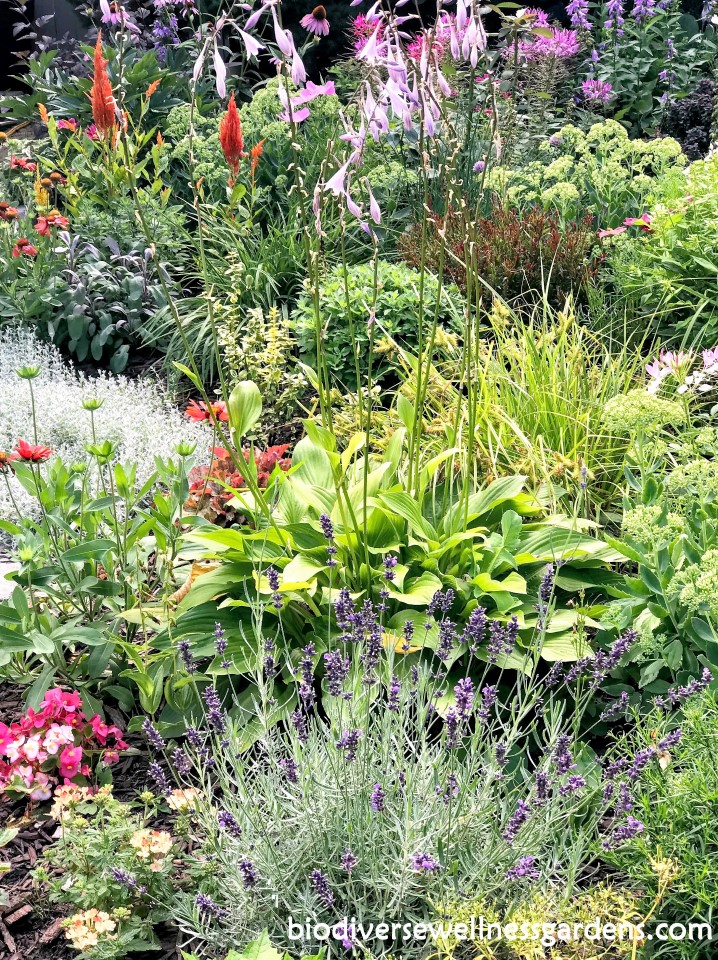
As science has demonstrated and how we ourselves have experienced, spending time in nature such as in a nature-based garden, reduces stress, elevates mood, promotes physical and psychological recovery and supports spiritual wellness. In turn, nature-based gardens support biodiversity by creating a habitat for creatures to visit and live in, and plants to feed on, thus fostering the interconnected relationship that we all share on this planet. For more information, check out this website’s tabs on “Gardens and Human Health” and “Biological Diversity.”
This human-nature wellness connection inspired creating this website with its aim to connect people to the wellness that nature provides by bridging the value that gardens offer to support human well-being and the biological diversity of life on earth (biodiversity).
With this in mind, the biodiverse wellness garden model was created. It focuses on taking natural elements that support human wellness and biodiversity into designing and creating a garden. Instead of viewing biodiversity and human wellness as separate, this type of garden offers a holistic approach to supporting both wildlife and human wellness.
A customized, comprehensive expert garden plan is available from biodiversewellnessgardens.com. These garden plans are custom designed to meet your vision, needs and budget. This service also designs biodiverse wellness gardens for specific uses. Our key goal is to offer a service that designs a garden, which both humans and biodiversity will enjoy! Please visit the “Contact” tab to connect with us to design your own Biodiverse Wellness Garden!
REFERENCES
10. Thompson, Richard. “Gardening for Health: A Regular Dose of Gardening.” Clinical Medicine. Vol. 18. No. 3: 201-5. 2018, p. 202.
11. Ulrich, RS. “View Through a Window May Influence Recovery From Surgery.” Science. 224: 420-1, 1984.18, in Thompson, Richard. “Gardening for Health: A Regular Dose of Gardening.” Clinical Medicine. Vol. 18. No. 3: 201-5. 2018, p. 202.
12. Thompson, Richard. “Gardening for Health: A Regular Dose of Gardening.” Clinical Medicine. Vol. 18. No. 3: 201-5. 2018, p. 202.
13. Cooper Marcus, C. and Barnes, M. Healing gardens: Therapeutic Benefits and Design Recommendations. New York: John Wiley & Sons.1999. In: “What Makes a Garden a Healing Garden?” By: Ulrika K Stigsdotter and Patrick Grahn. Journal of Therapeutic Horticulture.https://www.researchgate.net/publication/234072230_What_Makes_a_Garden_a_Healing_Garden
14. Kreitzer, Mary Jo. “What Are Healing Gardens?” University of Minnesota https://www.takingcharge.csh.umn.edu/explore-healing-practices/healing-environment/what-are-healing-gardens).
15. Ibid.
16. Andersen Hilton, Charlotte. “10 Surprising Ways That Gardening is One of the Healthiest Things You Can Do.” The Healthy https://www.rd.com/health/wellness/health-benefits-of-gardening/
17. Caspersen, C.J. et al. 1991. “The prevalence of selected physical activities and their relation with coronary heart disease risk factors in elderly men: the Zutphen Study. 1985. By: Evergreen Seeds. “Multiple Benefits of Community Gardens.”
http://www.gardeningmatters.org/sites/default/files/Multiple%20Benefits_2012.pdf) and https://www.evergreenseeds.com/multiple-benefit-of-community-garden/
Please support this website by making a donation. Your kindness is most appreciated!
Make a monthly donation
Make a yearly donation
Choose an amount
Or enter a custom amount
Your contribution is appreciated.
Your contribution is appreciated.
Your contribution is appreciated.
DonateDonate monthlyDonate yearly
 BIODIVERSE WELLNESS GARDENS