


“Help us to be ever faithful gardeners of the spirit, who know that without darkness nothing comes to birth, and without light nothing flowers”
– May Sarton
Traditional cultures and past ancient societies have known the mental health benefits that being surrounded by a garden offers. In recent times, science is catching up to recognizing gardening’s ability to reduce stress levels. Unhealthy amounts of stress take its toll on the body over the short and long term. Among the ailments unhealthy levels of stress can cause include:
- irritability,
- headaches,
- stomach aches,
- hormone imbalance
- inflammation,
- anxiety,
- pain,
- heart attacks and
- worsening pre-existing conditions in the body. (27)
VIEWING NATURE – A SIGHT FOR HUMAN WELLNESS
“The beauty of the natural world lies in the details” – Natalie Angler
Since we enjoy gardens through our various senses and particularly through our vision, it is interesting to understand the effects that garden views and nature in general have on human mental well-being. When we surround ourselves with growing plants and/or views of plants we are getting more than “a nice view.” That sensory experience stirs mysterious regenerative processes deep in our bodies and minds. (28)

For instance, “in a Japanese study, viewing plants altered EEG recordings and reduced stress, fear, anger, and sadness as well as reducing blood pressure, pulse rate and muscle tension.” (29) This has been found especially beneficial for hospital patients. Roger Ulrich, a leading environmental pscychologist studying these effects have shown in one of his studies that views of plants and trees from post-operative wards improved the mood of patients and reduced analgesic use, surgical complications and length of stay. Likewise, similar positive results have been found for patients undergoing dental treatment, and viewing natural scenes together with natural sounds improved the experience of bronchoscopy. Moreover, even randomly exposing post-operative patients to pictures of the countryside on their room’s walls can reduce pain and anxiety. Interestingly, pictures of abstract images increased patient anxiety (30).
It is no surprise then that indoor gardening has been used to treat patients with mental health issues. It is not only the appearance of plants that is beneficial to the viewer, but their leaves remove toxins, dust and microorganisms from the air, and plants also produce negative ions from their leaves. Similarly, work environments benefits from indoor plants. In one study for example, putting plants in a computer room improved productivity and lowered blood pressure (31). So the next time you think of sprucing up your surrounding space, consider adding plants to gain the added health benefits.
STRESS LEVELS
“How fair is a garden amid the trials and passions of existence”
– Benjamin Disraeli
Many studies show that after a stressful event, images of nature very quickly produce a calming effect. Within three to four minutes after viewing nature scenes, blood pressure, respiration rate, brain activity, and the production of stress hormones all decrease and mood improves. This again has an evolutionary advantage because it allows us to recuperate and recover our energy quickly. This ability to recover from stress quickly to be ready to respond to new threats was important for our ancestors’ survival (32).
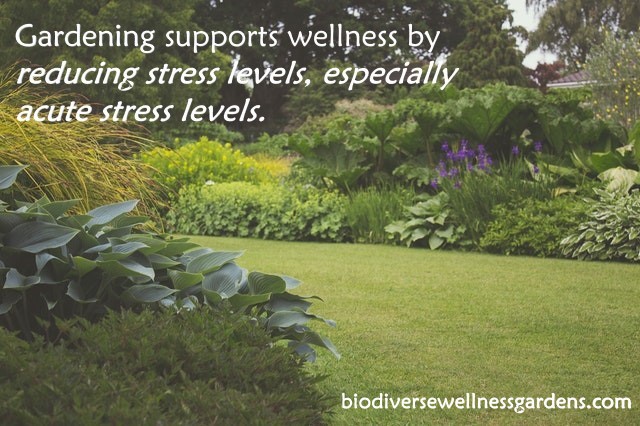
One study published in the Journal of Health Psychology noted the benefits of gardening reducing stress levels, especially acute stress levels. Each activity led to decreases in cortisol during the recovery period, but decreases were significantly stronger in the gardening group. Positive mood was fully restored after gardening, but further deteriorated during reading (33).
FLOWER POWER
“Happiness held is the seed; Happiness shared is the flower”
– John Harrigan
What’s more, flowers too support our health. For more than 5000 years, humans have cultivated flowers and the practice continues to persist today. In behavioural research conducted at Rutgers University by Jeanette M Haviland-Jones, the results demonstrated that flowers are a natural and healthful moderator of moods and have an immediate impact on happiness, a long-term positive effect on mood, and make for intimated connections between individuals (35).

SENSORY STIMULATION BENEFITS
“The greatest gift of the garden is the restoration of the five senses”
– Hanna Rion
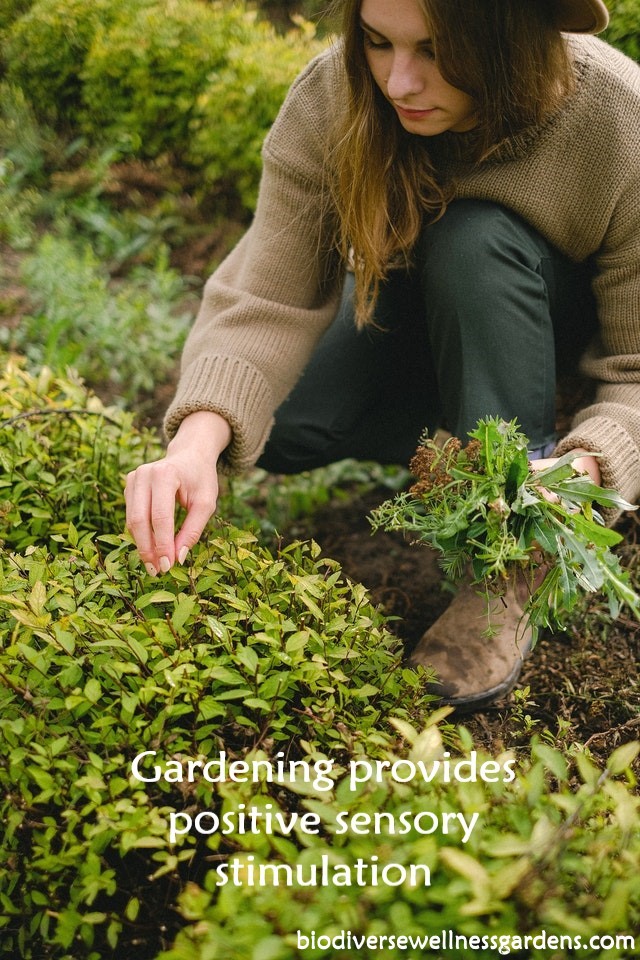
Just as gardening offers stress relief, it also provides positive sensory stimulation. A case in point comes from NASA in monitoring astronauts’ gardening activities in outer space. The act of gardening helped keep astronauts in a positive mind set. They found that planting and nurturing seeds, even just in small pots, provided great mental health benefits (36). In particular, astronauts found that working with plants provided visual, tactile and olfactory stimulation, and eventually even salivary stimulation with fresh foods and variety. It was also noted by the behavioural health team that another important countermeasure to sensory deprivation is the importance of being involved in meaningful work. “Several astronauts agree that the ability to watch plants grow, and to play a part in their growth, provides a strong connection to something bigger than their immediate surroundings.” (37)
GARDEN THERAPY
“Gardening is cheaper than therapy and you get tomatoes” – Author Unknown
Supporting this finding of garden cultivating providing meaningful work is the growing field of “horticultural therapy”, which is providing proven results for patients with depression and other mental illnesses. Similar to the astronauts’ experience in outer space, the benefits of gardening for these patients appear to spring from a combination of physical activity, awareness of natural surroundings, cognitive stimulation and the satisfaction of the work (38).
PRACTICING BEING IN THE PRESENT MOMENT
“Look at a tree, a flower, a plant. Let your awareness rest upon it. How still they are, how deeply rooted in being. Allow nature to teach you stillness”
– Eckhart Tolle
Gardening is definitely worth trying out to provide a sense of calmness, focus and feeling well rooted in the present moment. Pruning shrubs, deadheading (snipping off fading flowers) and hand weeding are just a few activities that can allow you to clear your mind. Other jobs allow you to focus while other tasks like waiting for plants to grow teach patience. Most allow you to immerse yourself in the present rather than stressing about the past or future while other gardening tasks stimulate your senses of smell and touch (39).
GARDENING SUPPORTS SOCIAL WELL-BEING
“The roots of all goodness lie in the soil of appreciation for goodness”
– Dalai Lama
Humans are social creatures and thrive when we have meaningful social relationships. Gardening helps to foster positive social relationships and cultivate compassion within and amongst individuals through a connection with nature. Research demonstrates that people who spend extended lengths of time around plants tend to have better relationships with others. “This is due to measurable increases in feelings of compassion; another effect of exposure to ornamental plants. Studies have shown that people who spend more time around plants are much more likely to try to help others and often have more advanced social relationships.” Moreover, people who care for nature are more likely to care for others, extending help to their peers and creating shared bonds developed from their common interests. Also, being exposed to nature and wildlife increases people’s compassion for each other as it increases people’s compassion for the environment in which they live. Thus, being around plants can help to improve relationships between people and increase their concern and empathy toward others (44).
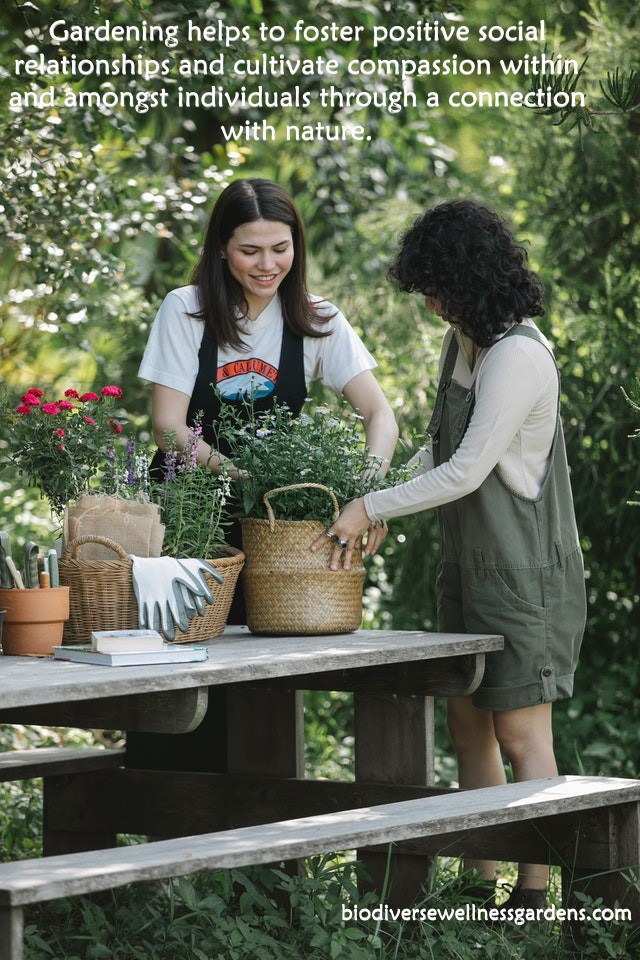
Similarly, the phenomenon of community gardens supports social well-being by encouraging people to get outside more into green spaces, connecting with others sharing an interest in gardening, making new friends and fostering community involvement. These community gardens are created in various settings including: school properties, churches, city parks, senior citizens’ residences, and community and health centers. Along with the physical and mental benefits of gardening and eating healthy foods, are the benefits are the social bonds we make through our interactions with other involved gardeners. What’s more, gardening supports healthy communities through:
- the beautification and revitalization of local areas,
- increased positive neighbourhood interaction, supports a safer place for children, and
- supports community values and cohesion.
These elements together can decrease violence while fostering healthier, more livable neighbourhoods (45).
OUTDOOR NATURE BENEFITS FOR CHILDREN
“In every gardener there is a child who believes in The Seed Fairy”
– Robert Breault
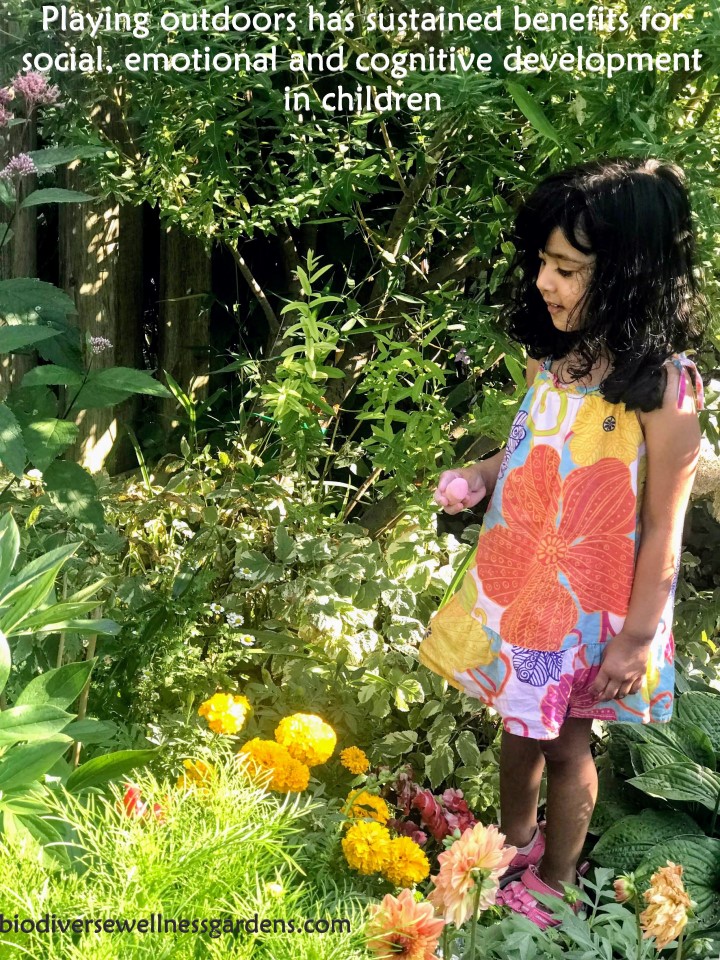
There is ample cumulative research on the benefits for children of playing in natural environments. “Playing in outdoor environments, whether at home, school, or camp, has sustained benefits for social, emotional, and cognitive development in children. Nature provides both the platform and the objects for play (46). It encourages exploration and building among older children which aids orientation and wayfinding, group decision-making, knowledge of how to respond to changing contexts, and improved problem-solving. Among younger children, small-scale natural environments with props (flowers, stones, sticks, water) stimulate imaginative play which is considered a cornerstone of social and cognitive development.” (47) “Natural outdoor spaces appeal to children because they are transformable and have multiple uses. As Robin Moore notes, what children really need for play is “unused space and loose parts” (48). If given the opportunity, children will use whatever they find in nature as play materials. Leaves, rocks, sand, water, branches, and flowers are all used to construct and transform an ordinary space into a magical one through imaginative play. What’s more, natural spaces also support imaginative play more effectively than most built structures because their features are readily transformed into different contexts.” (49)
As science has demonstrated and how we ourselves have experienced, spending time in nature such as in a nature-based garden, reduces stress, elevates mood, promotes physical and psychological recovery and supports spiritual wellness. In turn, nature-based gardens support biodiversity by creating a habitat for creatures to visit and live in, and plants to feed on, thus fostering the interconnected relationship that we all share on this planet. For more information, check out this website’s tabs on “Gardens and Human Health” and “Biological Diversity.”
With this in mind, the biodiverse wellness garden model was created. It focuses on taking natural elements that support human wellness and biodiversity into designing and creating a garden. Instead of viewing biodiversity and human wellness as separate, this type of garden offers a holistic approach to supporting both wildlife and human wellness.
A customized, comprehensive expert garden plan is available from biodiversewellnessgardens.com. These garden plans are custom designed to meet your vision, needs and budget. This service also designs biodiverse wellness gardens for specific uses. Our key goal is to offer a service that designs a garden, which both humans and biodiversity will enjoy! Please visit the “Contact” tab to connect with us to design your own Biodiverse Wellness Garden!
REFERENCES
28. Franklin, Deborah. “How Hospital Gardens Help Patients Heal: Hospital Gardens Turn out to have Medical Benefits.” Scientfic American. March 1, 2012. https://www.scientificamerican.com/article/nature-that-nurtures/
29. Thompson, Richard. “Gardening for Health: A Regular Dose of Gardening.” Clinical Medicine. Vol. 18. No. 3: 201-5. 2018.
30. Thompson, Richard. “Gardening for Health: A Regular Dose of Gardening”. Clinical Medicine. Vol. 18. No. 3: 201-5. 2018, p. 201.
Heerwagen, Judith. “Biophilia, Health, and Well-being”. 2009. In: Restorative Commons: Creating Health and Well-being Through Urban Landscapes. U.S Department of Agriculture, Forest Service, Northern Research Station, p. 42-43.
31. Thompson, Richard. “Gardening for Health: A Regular Dose of Gardening.” Clinical Medicine. Vol. 18. No. 3: 201-5. 2018.
32. Kreitzer, Mary Jo. “Taking Charge of Your Health: What are Healing Gardens.” University of Minnesota and the Earl E. Bakken Center for Spirituality and Healing. https://www.takingcharge.csh.umn.edu/explore-healing-practices/healing-environment/what-are-healing-gardens.
33. Williams, Chris. “The Science is In: Gardening is Good for You.” The Conversation. http://theconversation.com/the-science-is-in-gardening-is-good-for-you-65251.
Kreitzer, Mary Jo. “What Are Healing Gardens?” University of Minnesota https://www.takingcharge.csh.umn.edu/explore-healing-practices/healing-environment/what-are-healing-gardens).
34. Van Den Berg, Agnes and Custers, H.G, Mariette. “Gardening Promotes Neuroendocrine and Affective Restoration from Stress.” Journal of Health Psychology. Vol. 16, p. 3-11. http://journals.sagepub.com/doi/abs/10.1177/1359105310365577
35. Sorin, Fran. “13 Reasons Why Gardening is Good for Your Health.” Gardening Gone Wild. https://gardeninggonewild.com/13-reasons-why-gardening-is-good-for-your-health/
36. Andersen Hilton, Charlotte. “10 Surprising Ways That Gardening is One of the Healthiest Things You Can Do.” The Healthy. https://www.thehealthy.com/mental-health/self-care/health-benefits-of-gardening/
37. Nasa/Johnson Space Center. “Zinnias from Space! NASA Studies the Multiple Benefits of Gardening.” Science Daily. January 2016. https://www.sciencedaily.com/releases/2016/01/160121121528.htm
38. Jacobs, Robin. “6 Unexpected Health Benefits of Gardening.” Eartheasy. September 19, 2014. http://learn.eartheasy.com/2014/09/6-unexpected-health-benefits-of-gardening/
39. Gates, Jane. “Gardening: The Wonderdrug.” June 9, 2014 Fix.
44. Sorin, Fran. “13 Reasons Why Gardening is Good for Your Health.” Gardening Gone Wild. https://gardeninggonewild.com/13-reasons-why-gardening-is-good-for-your-health/
45. Cooper, Harriet. “The Dirt on Gardening: 6 Surprising Health Benefits.” Alive. January 18, 2017. https://www.alive.com/lifestyle/the-dirt-on-gardening/
46. Kahn, H, Peter, Jr. and Kellert, R, Stephen. Children and Nature: Psychological, Sociological and Evolutionary Investigations. MITT Press: London, 2002.
47. Heerwagen, Judith. “Biophilia, Health, and Well-being”. 2009. In: Restorative Commons: Creating Health and Well-being Through Urban Landscapes. U.S Department of Agriculture, Forest Service, Northern Research Station, p. 47.
48. Moore, Robin and C.C, Marcus. “Healthy Planet, Healthy Children: Designing Nature into the Daily Spaces of Childhood.” In Biophilic Design: The Theory, Science and Practice of Bringing Buildings to Life. January 1, 2008.
49. Heerwagen, Judith. “Biophilia, Health, and Well-being.” 2009. In: Restorative Commons: Creating Health and Well-being Through Urban Landscapes. U.S Department of Agriculture, Forest Service, Northern Research Station, p. 54.
Please support this website by making a donation. Your kindness is most appreciated!
Make a monthly donation
Make a yearly donation
Choose an amount
Or enter a custom amount
Your contribution is appreciated.
Your contribution is appreciated.
Your contribution is appreciated.
DonateDonate monthlyDonate yearly
 BIODIVERSE WELLNESS GARDENS