Discover the timeless reasons people garden and how gardens have evolved over the centuries. Explore the history, cultural significance, and joy of gardening.
“Everything that slows us down and forces patience, everything that sets us back into the slow circles of nature, is a help. Gardening is an instrument of grace.” – Francis Bacon
A garden can be defined in a variety of ways. For instance, it can be described as: “1) a plot of ground where herbs, fruits, flowers,or vegetables are cultivated; 2) a rich well cultivated region; 3) a container (such as a window box) planted with usually a variety of small plants; 4) a public recreation area or park usually ornamented with plants and trees i.e. a botanical garden; an 5) open-air eating or drinking place; and 6) a large hall for public entertainment” (1).
While it can be defined as incorporating a variety of these elements, gardening also creatively intertwines art and science. It artfully arranges plants for aesthetic appeal, planting flora in harmonious designs to suit their surroundings, while incorporating science through the principles and techniques of plant cultivation. Since gardens are a human construct, with these outdoor spaces often differing a lot from their natural environment, plants are grown in conditions that can vary significantly from their original environments. This is where the gardener’s experience comes into play, applying and modifying cultivation techniques stemming from plant physiology, chemistry and botany. Worldwide, the essential principles to grow plants are the same; however, a gardener will adapt these principles to suit local conditions. (2)
WHY GARDEN?
“I think this what hooks one to gardening: it is the closest one can come to being present at creation.;” – Phyllis Theroux
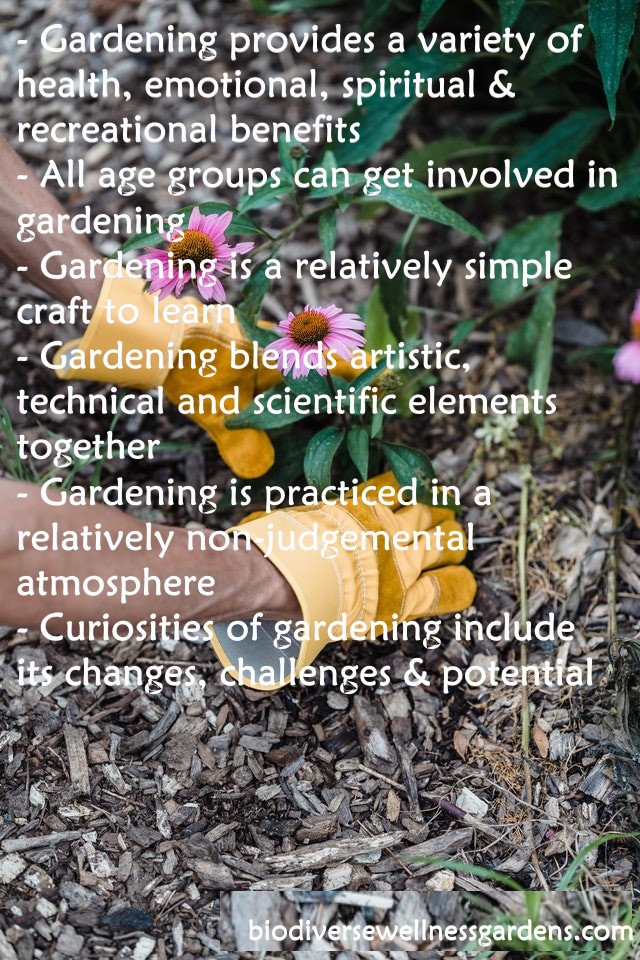
Gardening offers a variety of attractions to those interested in pursuing it including health, emotional, spiritual and recreational benefits. It is one of the few mediums where artistic, technical and scientific elements weave together and where a gardener without special training in these areas, can create human -made landscapes with natural elements. All age groups to a certain extent, can practice gardening as it is a relatively simple craft to learn. Moreover, for the most part, gardens are adaptable and forgiving to the beginner gardener. Nature’s adaptability will work with times of neglect, which makes gardening a activity that is practiced in a relatively non-judgemental atmosphere. That being said, natural law does dictate that gardening is informed and rooted in primal rules, and understanding how to work with these rules to ensure positive outcomes. Yet a key curiosity of gardening is that the challenges and potential of one garden can be quite different from another garden. Here is where imaginative solutions unfold to such challenges and potentials to the gardener and where s/he portrays artistry and finds satisfaction.(3)
“Despite the gardener’s best intentions, Nature will improvise” – Michael P. Garafalo
As science has demonstrated and how we ourselves have experienced, spending time in nature such as in a nature-based garden, reduces stress, elevates mood, promotes physical and psychological recovery and supports spiritual wellness. In turn, nature-based gardens support biodiversity by creating a habitat for creatures to visit and live in, and plants to feed on, thus fostering the interconnected relationship that we all share on this planet. For more information, check out this website’s tabs on “Gardens and Human Health” and “Biological Diversity.”
With natural habitats becoming increasingly fragmented and reduced, plant, insect and animal species’ survival and well-being are at threat. As our planet becomes more urbanized, there is more of a need to establish and support green spaces for the health benefits they provide us and to help conserve biodiversity. As global citizens, there are many actions we can participate in to help improve the state of biological diversity while supporting our own wellness needs. One small way to accomplish this is through gardening!
With this in mind, the biodiverse wellness garden model was created. It focuses on taking natural elements that support human wellness and biodiversity into designing and creating a garden. Instead of viewing biodiversity and human wellness as separate, this type of garden offers a holistic approach to supporting both wildlife and human wellness.
A customized, comprehensive expert garden plan is available from biodiversewellnessgardens.com. These garden plans are custom designed to meet your vision, needs and budget. This service also designs biodiverse wellness gardens for specific uses. Our key goal is to offer a service that designs a garden, which both humans and biodiversity will enjoy!
HISTORY OF GARDENS
“A society grows great when old men plant trees whose shade they know they shall never sit in.” – Greek Proverb
Evidence of gardening dates back far in human history to the ancient world in places such as Egypt, Iraq, MesoAmerica, Greece and China to name a few. Large volumes of ancient literature including gardening instruction manuals record gardening’s practical and spiritual benefits such as those found in classical Greece and Rome. (4)
In Ancient Egypt around 2000 BC, archaeological evidence shows that Egyptians had ornamental gardens and that they were quite advanced in their design and food cultivation. Affluent Egyptians would plant trees for shade, but also planted a wide variety of flowers including roses, poppies, irises, daisies and cornflowers. Egyptians also like ponds in their gardens, as well as fragrant trees and shrubs. Gardens also had a spiritual component. Egyptians believed that their gods liked gardens and therefore, temples often had gardens. Also, certain trees were associated with particular gods and thus trees carried a particular reverence. (5)
Similarly, in the ancient world of Mesopotamia, beautiful gardens were created. During 900 to 612 BC, affluent Assyrians enjoyed beautiful gardens. Like the ancient Egyptians, affluent Assyrians planted trees for shade such as palms and cypresses, created ponds, cultivated vines and some flowers and created pleasure gardens irrigated by water canals. (6) In 612 BC, when the Assyrian empire was destroyed, the city-state of Babylon developed another large empire led by King Nebuchadnezzar. He is said to have developed one of the seven wonders of the ancient world – the hanging baskets of Babylon for his wife Amytis. These hanging gardens were actually comprised of a simulated mountain with rooftop gardens with likely multi-level terraces supported by backed brick columns. These columns would have been filled with dirt to support the large plantings and trees growing in them, which would give the effect of a mountain landscape, appearing hanging in mid-air. (7) Later in 539, the Babylon empire was ruined by the Persians, who then created their own great empire. These ancient Persians were excellent gardeners, whose legacy includes building aqueducts to bring water to their gardens without evaporating it. Similar to earlier civilizations, Persians grew fruit trees, fragrant shrubs, flowers and had pools, fountains and watercourses or rills. (8)
 Illustration above: Hanging Baskets of Babylon, Christopher Klein
The earliest Chinese gardens can be traced back to 1600 to 1046 BC during the Shang dynasty. These gardens were more like garden-parks of forests and woods dedicated to raising animals for hunting for nobility. (9) During the Southern and Northern dynasties period (420 – 581), landscape gardens began imitating nature and including poetic effects. These gardens further developed during the Tang and Song dynasties (618 – 1279). (10) However, traditional Chinese garden architecture in the real sense first emerged during the Tang dynasty around 618 – 907 AD. During this time, beautiful architecture was constructed to also include later man-made hills, pools and fountains. Over time, these gardens successfully blended in wells with the beauty of the natural environment. (11)
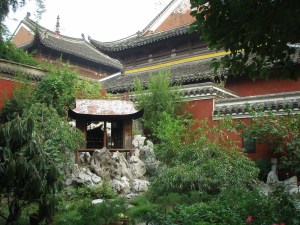
Taoist Temple, Zhejiang Province, China. Photo By: Sumudu Dissanayake
In ancient Greece, the focus was on growing plants for practical reasons. While the Greeks did grow flowers, they were usually in containers. Typically orchards, vineyards and vegetable gardens were grown and sometimes trees were planted around temples and public places. (12)
Ancient Romans, after conquering Egypt in 30 BC, introduced eastern ideas about gardening. Again, it was affluent Romans whom created gardens in their places, villas and their houses’ courtyards, which usually had a pool, fountain and beds of flowers. Ancient Romans were skilled in the art of topiary and often had statues and sculptures in their gardens, which were laid out with hedges and vines. (13) Ancient Romans used a variety of plants and flowers in their gardens. Herbs were grown in gardens for their culinary and medicinal uses. Some of the most popular herbs planted were thyme, mint, savory, celery seed, basil, bay and hyssop. Their gardens also had a variety of flowers including favourites such as roses, narcissi, oleanders, violets, crocus, narcissus, lily, gladioli, iris, poppy, amaranth and wildflowers. (14)
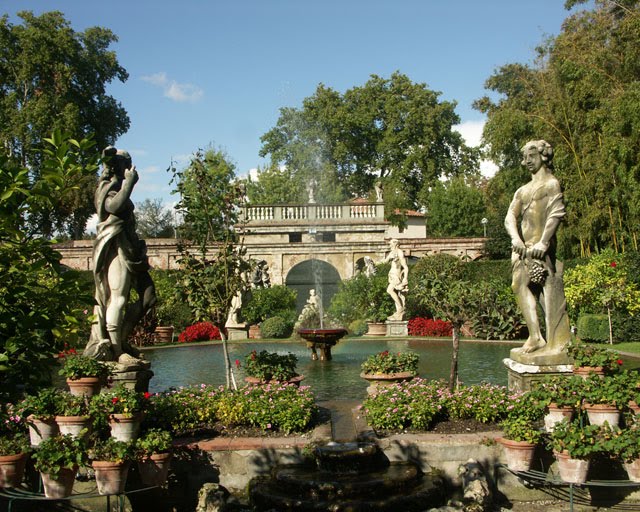
Photo of Roman garden by: Torin Golding
References
- Merriam-Webster Dictonary. Garden. https://www.merriam-webster.com/dictionary/garden
- Herklots, A.C Geoffrey et al. Encyclopaedia Britannica. “Gardening: Art and Science”. https://www.britannica.com/science/gardening
- Ibid.
- Ibid.
- Lambert, Tim. “A Brief History of Gardening”. http://www.localhistories.org/gardening.html
- Ibid.
- Ancient History Encyclopedia. ” The Hanging Gardens of Babylon: The Mysterious Wonder of the Ancient”. https://www.ancient.eu/article/129/the-hanging-gardens-of-babylon-the -mysterious-wond/
- Lambert, Tim. “A Brief History of Gardening”. http://www.localhistories.org/gardening.html
- Travel China Guide. “Chinese Garden Architecture”. https://www.travelchinaguide.com/intro/architecture/styles/garden.htm
- China Today. “Chinese Garden”. http://www.chinatoday.com/culture/chinese_garden.htm
- Travel China Guide. “Chinese Garden Architecture”. https://www.travelchinaguide.com/intro/architecture/styles/garden.htm
- Lambert, Tim. “A Brief History of Gardening”. http://www.localhistories.org/gardening.html
- Ibid.
- Sheldon, Natasha. Ancient History and Archaelogy.com ” Ancient Roman Gardens”. http://www.ancienthistoryarchaelogy.com/ancient-romans-gardens
Copyright © 2017 biodiversewellnessgardens.com All Rights Reserved – Privacy Policy
CONTINUE EXPLORING RELATED ARTICLES:
Healing Gardens – History and Recent Developments
Gardening Supports Human Wellness
Biodiversity Benefits Gardening
Creating a Biodiverse Wellness Garden
Please support this website by making a donation. Your kindness is most appreciated!
Make a monthly donation
Make a yearly donation
Choose an amount
Or enter a custom amount
Your contribution is appreciated.
Your contribution is appreciated.
Your contribution is appreciated.